British queen makes historic peace trip to Ireland
Undeterred by real or fake bombs, Queen Elizabeth II on Tuesday began the first visit by a British monarch to the Republic of Ireland, a four-day trip to highlight strong Anglo-Irish relations and the success of Northern Ireland peacemaking.
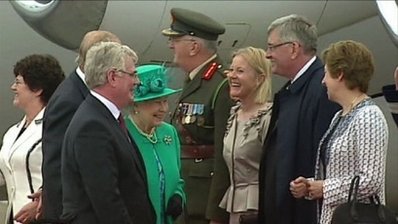
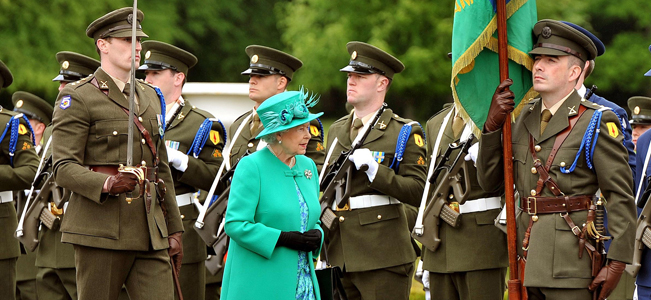
Resplendent in a cloak of emerald green and a dress of St. Patrick's blue, the 85-year-old queen stepped out from a bombproof, bulletproof Range Rover outside the official residence of Irish President Mary McAleese. Irish Army artillery units fired a 21-gun salute as a military brass band played "God Save the Queen."
The painstakingly choreographed visit has been designed to highlight today's exceptionally strong Anglo-Irish relations and the slow blooming of peace in neighboring Northern Ireland following a three-decade conflict that left 3,700 dead.
The queen arrived 100 years after her grandfather George V visited Dublin and an Ireland that was still part of the British Empire.
Beaming smiles by the queen and McAleese — a Belfast-born Catholic who has spent 14 years lobbying for Elizabeth II to visit — demonstrated genuine warmth between the two women, who have met several times before.
McAleese said Britain and Ireland were "determined to make the future a much, much better place." The queen didn't comment ahead of her planned speech Wednesday night at Dublin Castle, the former seat of British rule of Ireland.

Inside the president's residence, McAleese introduced the queen and husband Prince Philip to Irish Prime Minister Enda Kenny. Outside, the queen introduced the president to British Foreign Minister William Hague. The two leaders then planted a tree as two children rang the residence's Peace Bell.
A 33-motorcycle police escort led the queen to McAleese's residence in Dublin's vast Phoenix Park through the unusually empty streets of Dublin — cleared to ensure no anti-British extremist could launch an attack. Nearby Dublin Zoo was closed as a security precaution and no civilian aircraft were permitted over Dublin for the day.
Irish Republican Army dissidents opposed to reconciliation with Britain still tried to undermine the visit with real and hoax bombs, but they caused no significant disruption.
Irish Army experts overnight defused one pipe bomb on a Dublin-bound bus that was detected in Maynooth, 15 miles (25 kilometers) west of the capital. Police said the bomb was properly constructed but not primed to detonate.
A second device abandoned near a light-rail station in west Dublin was deemed a hoax Tuesday morning. Later, police responded to at least two more reports of suspicious packages in working-class districts of north Dublin, but no further bombs were confirmed.
Police said IRA dissidents using a recognized codeword warned about the bus bomb, which was left in overhead luggage.
Several small IRA splinter groups concentrated along the Irish border continue to plot gun and bomb attacks in Northern Ireland in hopes of undermining the success of its 1998 peace accord, particularly its stable Catholic-Protestant government.
But Irish and British officials were keen to stress that the queen's visit to Dublin, Kildare, Tipperary and Cork would proceed as planned — accompanied by the biggest security operation in the Republic of Ireland's history.
"This is the start of an entirely new beginning for Ireland and Britain," Kenny said. "I really do hope that the welcome she gets will be genuine and memorable for her."
On her first day in Dublin, the queen was also visiting Trinity College — founded in 1592 by her royal namesake, Queen Elizabeth I — and laying a wreath at the Garden of Remembrance, a central Dublin memorial that honors two centuries of Ireland's rebel dead.
The latter gesture has been designed to symbolize Britain's reconciliation with Ireland 90 years after a brutal guerrilla war led to independence for the Catholic south of the island.
More than 8,000 police, two-thirds of the entire country's police force, shut down key roads in central Dublin and erected pedestrian barricades for several miles (kilometers). About 1,000 Irish troops were kept in reserve.
Police made it extremely difficult for protesters to get within sight of any of the queen's engagements. Onlookers were given few vantage points to see the queen unless they had been included in carefully vetted guest lists.
A few dozen supporters of an anti-British pressure group Eirigi — Gaelic for "rise" — scuffled with police on Dublin's major thoroughfare several hundred yards (meters) from the Garden of Remembrance. No serious injuries were reported as police successfully moved the protesters to a fenced-off area.
Britain and Ireland spent decades in frosty opposition following Ireland's 1919-21 war of independence and the creation in 1922 of the Irish Free State. Northern Ireland, created in 1921, remained in the United Kingdom.
Ireland stayed neutral in World War II and offered condolences to Germany over Adolf Hitler's death. It broke all symbolic ties with Britain by declaring itself a republic in 1949 and offered sympathy and a relatively safe haven when the modern IRA in 1970 began shooting and bombing in Northern Ireland.
But after Britain and Ireland joined the European Union in 1973, and as the bloodshed in Northern Ireland spilled over into the Catholic south, the governments in London and Dublin gradually found common cause.
Their cooperation provided the essential bedrock for Belfast's Good Friday peace accord in 1998. IRA disarmament and a coalition government of Northern Ireland's British Protestant majority and its Irish Catholic minority eventually followed.
While the Irish remain proud of their independence, many concede that they are closely linked culturally and economically to their much bigger neighbor.
Today's Ireland is home to 4.5 million residents who watch British television and read newspapers daily, and shop in the British chain stores that dominate Irish retail life.
Many follow English and Scottish soccer with passion while the English, in turn, have made the Emerald Isle a favored tourist destination.
Ireland's struggle to prevent a national bankruptcy — the Irish have spent three years raising taxes and cutting spending, and six months ago received a euro67.5 billion ($95 billion) credit line from international lenders — has found its greatest champion in Britain, its No. 1 trading partner.
Prime Minister David Cameron's government offered Ireland a particularly low-interest loan and is pressing other European Union members to give the Irish a cheaper deal, too.